
Clinical Management of Pruritus in Chronic Urticaria: From Disease Burden to Rapid Pruritus Control Strategies with Second-Generation Antihistamines
Pruritus affects over 95% of patients with chronic urticaria and remains the symptom that most impacts quality of life. This conference review highlights rapid itch control, treat-to-target management, and the role of second-generation antihistamines.

Chronic urticaria ranks among the most common dermatological disorders. Pruritus is not only its most prominent symptom, but also the primary culprit that disturbs patients physically and mentally and impairs their quality of life. This article is adapted from the academic report delivered by Professor Yan Mu at the 2nd Skin Health Development Conference. It systematically summarizes the clinical status, disease burden and therapeutic dilemmas of chronic urticaria, and focuses on the core value of second-generation antihistamines represented by bilastine in rapid pruritus control and full-course disease management, so as to provide references for clinical diagnosis and treatment.

1 Pruritus Burden: The Core Concern for Most Patients
Chronic urticaria is a common dermatological disorder, with pruritus being its most prominent and prevalent symptomatic manifestation. A domestic multicenter clinical study shows that approximately 95.3% of patients with urticaria suffer from pruritus, with certain regional variations. The prevalence of pruritus reaches as high as 99.5% in northern China and 94.1% in southern China. Quantitative scoring of pruritus severity reveals that patients with moderate-to-severe pruritus account for up to 80.5%, including 75.6% with moderate pruritus and 4.9% with severe pruritus. The vast majority of patients endure intolerable pruritus.
Pruritus exerts multidimensional and profound impacts on patients’ quality of life. Patients commonly have impaired sleep quality, and families of pediatric patients are also affected as a whole. Long-standing persistent disease may induce emotional disorders such as anxiety and depression. Multidimensional quality-of-life questionnaires demonstrate that pruritus-related symptoms yield the highest scores and exert the greatest impact, followed by sleep disturbances and emotional abnormalities, which further compromise social functioning and facial appearance and bring about stigma in patients.
Patients have clear therapeutic expectations: most patients expect complete control of pruritus with rapid onset of relief, rather than waiting for months or even longer.
2 The Pruritus-Scratch Vicious Cycle: Why Must We Achieve Rapid pruritic Control?
Pruritus and scratching form a vicious cycle with reciprocal causation. During pathogenesis, histamine and a large number of pro-inflammatory and pruritogenic cytokines trigger scratching; scratching further damages keratinocytes and releases more cytokines to aggravate pruritus. Emotional disorders can induce neurogenic pro-inflammatory factors, resulting in intractable pruritus.
More critically, long-term pruritus can lead to central sensitization and form pruritic memory in brain regions including the hippocampus and amygdala, making it hard for patients to voluntarily stop scratching behaviors. Therefore, breaking this vicious cycle and achieving rapid pruritus relief is the most essential step in the treatment of chronic urticaria.
3 Treat-to-Target: Achieving "Complete Control" Within 12 Weeks
China’s guidelines for the diagnosis and management of urticaria put forward the treat-to-target management concept, consistent with international guidelines: early intervention, complete symptom control, full-course maintenance therapy, and regular and rational dose tapering and discontinuation.
"Complete control" refers to zero pruritus and no wheal formation validated by rating scales, such as a UCT score ≥16 or UAS7 = 0. The timeliness requirement is to achieve effective symptom control within 12 weeks, ultimately leading to little or no impairment of patients’ quality of life.
Surveys indicate that physicians and patients have slightly different priorities. Physicians pay more attention to the duration and recurrence of pruritus, while patients are more concerned about pruritus intensity and its impacts on sleep and social interaction. In clinical practice, alleviating patients’ subjective "pruritus sensation" should be set as the core therapeutic goal.
4 Second-Generation Antihistamines: First-Line Choice and Cornerstone Throughout the Entire Course
Pruritus is mediated by multiple substances, and its pathogenesis mainly involves two pathways:
First, histamine-dependent pruritus: Mast cells and basophils undergo degranulation and release histamine and numerous pro-inflammatory mediators. These mediators bind to receptors on sensory neurons, triggering immediate pruritus, vascular exudation and increased permeability, which belongs to an immediate hypersensitivity reaction.
Second, histamine-independent pruritus: During persistent inflammation, pro-inflammatory cytokines including leukotrienes, IL-4, IL-13 and IL-31 are highly expressed, accompanied by type 2 inflammation, epidermal alarmin release, adaptive immune responses and lymphocyte chemotaxis. Persistent symptoms in refractory urticaria are closely associated with sustained activation of eosinophils and polymorphonuclear leukocytes at tissue sites.

Second-generation antihistamines exert antipruritic effects via a dual mechanism. On the one hand, they directly block histamine H1 receptors, reduce vasodilation and vascular permeability, inhibit the activation of sensory nerve terminals and deliver immediate pruritus relief. On the other hand, they downregulate NF-κB and calcium-related channels to mitigate excessive activation of antigen-presenting cells and suppress the expression of pro-inflammatory cytokines and chemokines.
The updated 2026 European international urticaria guidelines, China’s 2022 urticaria diagnosis and treatment guidelines, and treat-to-target consensus consistently recommend second-generation antihistamines as first-line therapy for chronic urticaria. Dose escalation (up to four times the standard dose) is recommended when standard doses fail to work.
Recommended Treatment Algorithm of the International Urticaria Guideline:
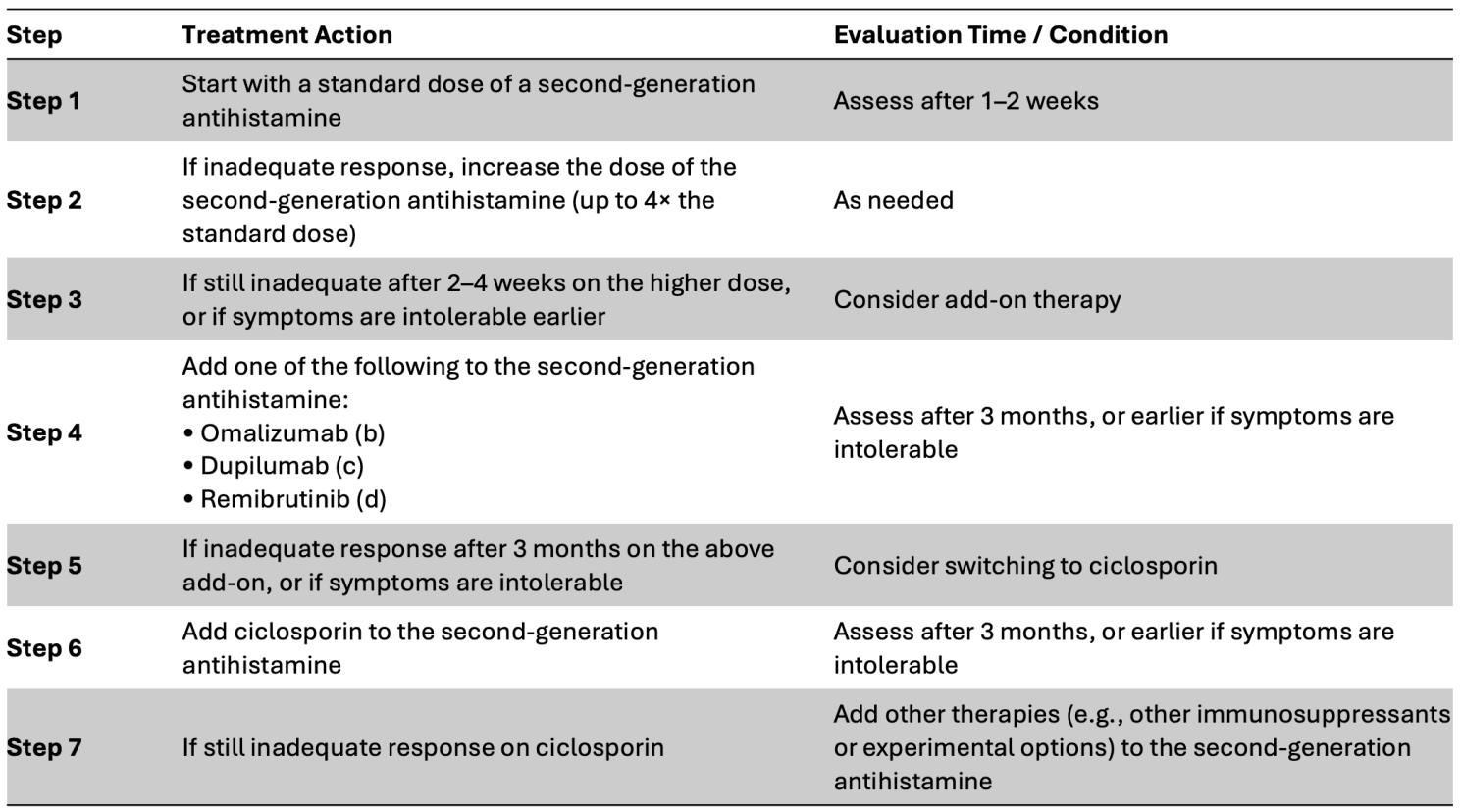
In this stepwise therapeutic algorithm, second-generation antihistamines serve not only as first-line agents but also as cornerstone medications throughout the whole treatment course. Clinical trials of novel agents including phase 3 trials of remibrutinib, phase 2 trials of fenebrutinib and phase 3 trials of dupilumab, all adopted second-generation antihistamines as background therapy in trial design. This strategy ensures symptom control in the control group, avoids confounding factors, and facilitates objective evaluation of the efficacy of new drugs.
5 Bilastine: Rapid Pruritus Relief Without Central Sedative Effects
Bilastine is a representative second-generation antihistamine with favorable efficacy and safety profiles.
Onset of action: Onset within 30 minutes, marked pruritus relief at 2 hours
Bilastine exerts therapeutic effects starting at 30 minutes, reaches peak plasma concentration at approximately 1.3 hours, and achieves significant pruritus relief at 2 hours. Clinical studies demonstrate that pruritus scores in the bilastine group decrease significantly compared with the placebo group starting from Day 1 of treatment, and this effect lasts through Week 2.
Comparative efficacy: Significantly superior to desloratadine and rupatadine A phase IV randomized, double-blind, placebo-controlled crossover study showed that 20 mg bilastine produced significantly better antipruritic effects than placebo at 2 h, 4–6 h, 9 h and 12 h post-dosing, while desloratadine and rupatadine showed no statistically significant difference versus placebo at any time point.
Central safety: Virtually no sedation to meet the demand for "alert pruritus relief" Bilastine has one of the lowest cerebral histamine H1 receptor occupancy rates among marketed antihistamines and nearly no central inhibitory effects. A Formula 1 high-speed driving simulator test showed that 7 days of bilastine treatment did not impair attention or reaction capacity. Stanford Sleepiness Scale assessments revealed that somnolence scores within 6 hours after dosing were comparable to placebo. Bilastine also does not compromise flight vigilance or tracking task performance.
This property is especially valuable for patients engaged in high-attention activities such as driving, working at heights and studying. The incidence of somnolence-related adverse events is markedly lower with bilastine than desloratadine.
6 Real-World Cases: Clinical Evidence for Bilastine’s "Rapid" and "Sustained" Profile
Acute urticaria case: A 31-year-old male presented with generalized red wheals and pruritus for 2 days. Oral loratadine yielded no obvious improvement, and total IgE was markedly elevated (331 kU/L). After switching to bilastine 20 mg once daily (qd), skin lesions were markedly alleviated and pruritus was significantly relieved within only 30 minutes.
Chronic urticaria with angioedema case: A 24-year-old female college student suffered from severe pruritus that disturbed sleep, study and social activities. Previous treatment with diphenhydramine 25 mg three times daily (tid) was ineffective. Bilastine 20 mg twice daily (bid) was initiated; partial symptom improvement was observed after 7 days. The dose was then escalated to 40 mg bid (80 mg/day, 4 times the approved dose, consistent with the guideline-recommended maximum 4-fold dose escalation). After 4 weeks of treatment, pruritus and wheals were completely cleared, followed by gradual dose tapering for maintenance. Note: The approved dose in China is 20 mg qd. Off-label dose escalation requires informed consent from the patient.
7 Summary
Chronic urticaria imposes a heavy pruritus burden. Over 95% of patients suffer from pruritus, which impairs quality of life across multiple dimensions. Rapid pruritus relief and long-term stable symptom control have become patients’ core therapeutic demands. Second-generation antihistamines deliver hour-scale rapid onset to block histamine effects, and concurrently inhibit inflammatory pathways and the release of pro-inflammatory mediators. They not only rapidly relieve pruritus, but also help modulate chronic inflammation and reduce recurrence.
Both Chinese and international authoritative guidelines consistently recommend second-generation antihistamines as the first-line therapeutic option for urticaria. Among these agents, bilastine features an onset of action within 30 minutes, superior pruritus relief compared with some other comparators, low central nervous system inhibition and no significant sedative effects. While meeting patients’ demand for "rapid pruritus relief", it fulfills safety requirements for daily work and study, making it a noteworthy therapeutic option in clinical practice.
Expert Profile

Professor Yan Mu
Second Hospital of Jilin University
Specializes in the diagnosis and treatment of common infectious, allergic, inflammatory, autoimmune and cutaneous adnexal diseases in dermatology, and precise diagnosis of dermatoses based on cutaneous histopathological diagnostic techniques.