
Confronting the Burden of Facial Atopic Dermatitis: New Insights into Managing Head and Neck Atopic Dermatitis
Professor Haihong Qin of Huashan Hospital, Fudan University, explores the disease burden, complex inflammatory mechanisms, and emerging treatment strategies for head and neck atopic dermatitis, including the role of upadacitinib.

Atopic Dermatitis (AD) is one of the most common chronic inflammatory skin disorders encountered in dermatology. When lesions affect exposed areas of the head and neck, the disease burden escalates substantially: this condition is not only refractory and prone to relapse, but also exerts a direct toll on patients’ appearance, social functioning and mental wellbeing.
This article is adapted from the academic lecture Facing Facial Disease, Regaining Quality of Life: Exploring Upadacitinib for Head and Neck Atopic Dermatitis, delivered by Professor Qin Haihong from Huashan Hospital, Fudan University, at the 2nd Skin Health Development Conference. The lecture systematically reviews the disease burden, pathogenesis and therapeutic advances of head and neck AD, and discusses how highly selective Janus Kinase 1 (JAK1) inhibitors, represented by upadacitinib, offer novel therapeutic strategies for this unmet clinical challenge.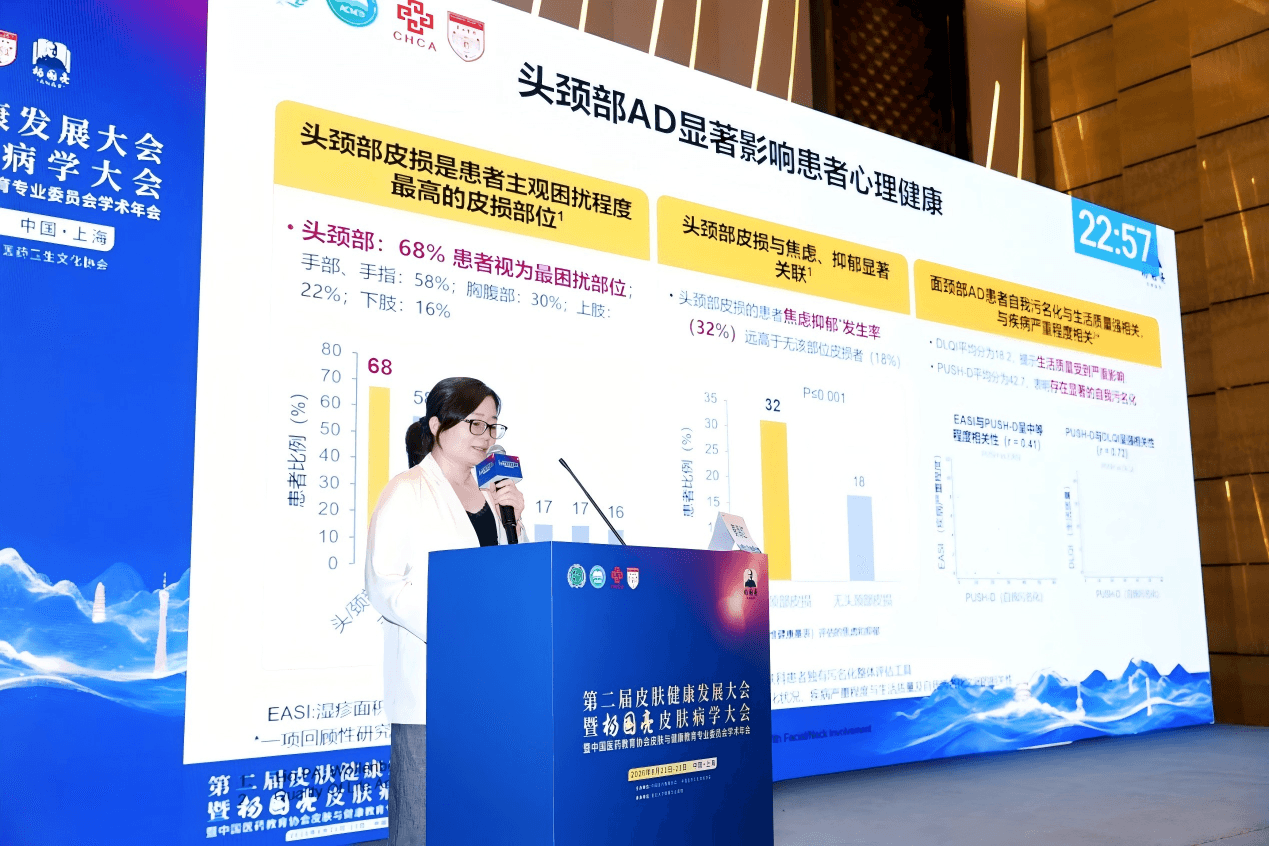
1 Head and Neck Atopic Dermatitis
Head and neck AD is characterised by a protracted disease course, high treatment difficulty and elevated relapse rates. Given the exposed nature of these sites, its impact on patients’ quality of life is particularly profound. An international survey demonstrated that even patients with isolated head and neck lesions experience multidimensional disease burden: 40.52% reported fatigue, 36.43% low mood and 33.83% difficulty falling asleep. Approximately one in five patients reported being avoided for physical contact (20.82%), rejected or socially isolated (16.36%), experiencing discrimination (16.36%), feeling socially distanced from others (14.87%), and impaired sexual function (17.15%).
Patients rank head and neck lesions as the most subjectively distressing site: 68% identified this region as their most troublesome skin involvement, far exceeding the hands (58%), legs (30%), upper limbs (24%), lower limbs (19%) and face (16%). Meanwhile, head and neck lesions show a significant association with anxiety and depression: the prevalence of anxiety and depression reaches 32% among patients with head and neck involvement, compared with only 18% in those without lesions at these sites (P<0.001).
A survey examining self-stigma in patients with facial and neck AD reported a mean Perceived Understanding, Stigma and Distress (PUSH-D) score of 42.7, indicating substantial self-stigmatisation. The mean Dermatology Life Quality Index (DLQI) score was 18.2, reflecting severe impairment of quality of life. Further analyses revealed a strong correlation between PUSH-D and DLQI (r=0.72), and a moderate correlation between PUSH-D and disease severity measured by the Eczema Area and Severity Index (EASI) (r=0.41). The psychological burden arising from facial concerns constitutes an unavoidable consideration in the management of head and neck AD.
2 Exploration of Pathogenesis
The pathogenesis of head and neck AD can be summarised into four core domains: immune inflammation, impaired skin barrier function, altered skin microbiome and medication-related factors. These four mechanisms do not operate independently; instead, they interact and reinforce one another to form a complex disease network, conferring unique features that distinguish head and neck AD from classic AD.
-Immune phenotype: marked elevation of Th1/Th17 inflammation
Unlike classic AD, which is conventionally recognised as predominantly type 2 inflammation-driven, head and neck AD involves substantial non-type 2 inflammatory pathways. Multiple studies have demonstrated that inflammation mediated by T helper 1/17 (Th1/Th17) cells is significantly increased in head and neck lesions compared with truncal lesions, with clear differences observed at both messenger RNA (mRNA) and protein levels. Th1 chemokines C-X-C motif chemokine ligand 9/10 (CXCL9/10) in head and neck tissue were (23.45 vs 11.26) and (21.07 vs 7.68, P<0.001) respectively, while the Th17-related mediator Interleukin-17 (IL-17) was (1.06 vs 0.45, P<0.001); all values were significantly higher than those in truncal skin. Such regional variation in inflammatory phenotype may directly influence treatment response.
-Skin barrier and microbiome
As exposed sites, the skin of the head and neck is more vulnerable to environmental insults. Barrier dysfunction triggers dysregulated immune responses, and shifts in cutaneous microbiota further exacerbate this imbalance. In untreated patients with relapsing AD, the mean proportion of Staphylococcus aureus on lesional skin reaches 65±3.5%, markedly higher than in other disease states. Facial fungal community diversity increases substantially, with Malassezia becoming the dominant genus within lesions. Lesions on the head and neck contain higher loads of Malassezia restricta and Malassezia globosa than healthy skin, and these levels correlate with disease severity. Furthermore, studies have noted a significant rise in Demodex detection within lesions during dupilumab therapy for AD, which may underlie rosacea-like follicular reactions on the face.
A vicious cycle is therefore established: shifts in cutaneous colonising microbiota → microbiome dysbiosis → barrier dysfunction → cytokine imbalance, which continuously amplifies local inflammation.

3 Medication-Associated Head and Neck Dermatitis
With the widespread adoption of biologics for AD management, a new clinical entity has been increasingly recognised: medication-associated head and neck dermatitis. Studies show that approximately 10% of patients receiving dupilumab may develop Dupilumab-Associated Head and Neck Dermatitis (DAHND). Lesions typically present as oedematous erythema with minimal scaling, and histology favours psoriasiform changes. The condition occurs predominantly in adults, with a slight male predominance, and usually emerges around week 11 of treatment.
Its pathogenesis is thought to involve two key pathways. First, hypersensitivity reactions triggered by Malassezia infection or Demodex colonisation. Second, immune shift following blockade of T helper 2 (Th2)-associated inflammatory mediators: suppression of Interleukin-13 (IL-13) alongside upregulation of Interleukin-22 (IL-22) and Aryl Hydrocarbon Receptor (AHR)-mediated inflammation. Evidence suggests that the IL-17 inflammatory pathway may play an important role in the pathogenesis and treatment response of facial and neck AD.
This phenomenon is also reflected in real-world data. A Danish nationwide prospective cohort followed 347 adults with moderate-to-severe AD for 104 weeks. At baseline, 76% had head and neck involvement; after 104 weeks of treatment, 68% still had persistent lesions in these regions. Head and neck AD thus appears to be persistent, with limited response to dupilumab.
Multiple national and international consensus documents have issued warnings. The Chinese Expert Consensus on the Clinical Pathway for Diagnosis and Management of Moderate-to-Severe Atopic Dermatitis (2023 Edition) advises monitoring for adverse events including conjunctivitis and head and neck dermatitis during biologic therapy, with prompt symptomatic management as required. The ExpertConsensus on the Use and Management of Therapeutic Agents for Atopic Dermatitis (2024 Edition) also notes facial and neck dermatitis after dupilumab, recommending treatment discontinuation in severe cases. The Italian Delphi consensus further proposes that JAK inhibitors may be preferred as first-line therapy for patients with moderate-to-severe AD involving sensitive sites (face/neck, hands, genitalia), potentially outperforming biologics (100% agreement among the expert panel).
4 Targeted Therapy with Upadacitinib
-Mechanistic basis: multi-pathway inflammatory blockade
The JAK1 signalling cascade participates in nearly all key immune-mediated inflammatory pathways relevant to AD, including Th2, Th17, T helper 22 (Th22) and Th1 responses. As a highly selective JAK1 inhibitor, upadacitinib broadly suppresses downstream signalling across multiple inflammatory pathways. This enables more comprehensive coverage of the non-type 2-skewed immune phenotype characteristic of head and neck AD, which may underpin its superior efficacy in this subgroup.
-Randomised controlled trial evidence
In the Measure Up programme, stratified by baseline head and neck EASI scores, a significantly higher proportion of patients receiving upadacitinib 15 mg and 30 mg achieved Minimal Disease Activity (MDA; defined as EASI 90 plus Worst Pruritus Numerical Rating Scale [WP-NRS] 0/1) compared with placebo. Among patients with severe head and neck AD (baseline EASI 4–7.2), 37.8% of those on upadacitinib 30 mg attained MDA versus only 0.7% in the placebo arm.
The Heads Up study was a head-to-head trial comparing upadacitinib 30 mg with dupilumab, comprising a 24-week double-blind phase plus a 52-week open-label extension. Subgroup analyses demonstrated that at week 24, EASI 90 response rates for head and neck, upper limb, truncal and lower limb lesions were all significantly higher in the upadacitinib group than in the dupilumab group, with clinical benefit evident as early as weeks 2–4 and sustained thereafter.
Switching to upadacitinib also delivers rapid, marked improvements in patients previously treated with dupilumab. In Heads Up, patients who received dupilumab for 24 weeks during the double-blind phase and then switched to upadacitinib achieved head and neck EASI 75 in 81.3% at week 4 post-switch; the EASI 90 response rate reached 63.8% at week 16. The reduction in head and neck EASI from baseline increased by a further 41.8% after switching. In the Level Up study (response-guided treatment adjustment), EASI 75 rose from 57.1% to 66.7% and EASI 90 from 35.1% to 46.5% in patients switching therapy in phase 2. At week 16 after switching, the reduction in head and neck EASI from baseline increased by 46%.
-Long-term safety and real-world validation
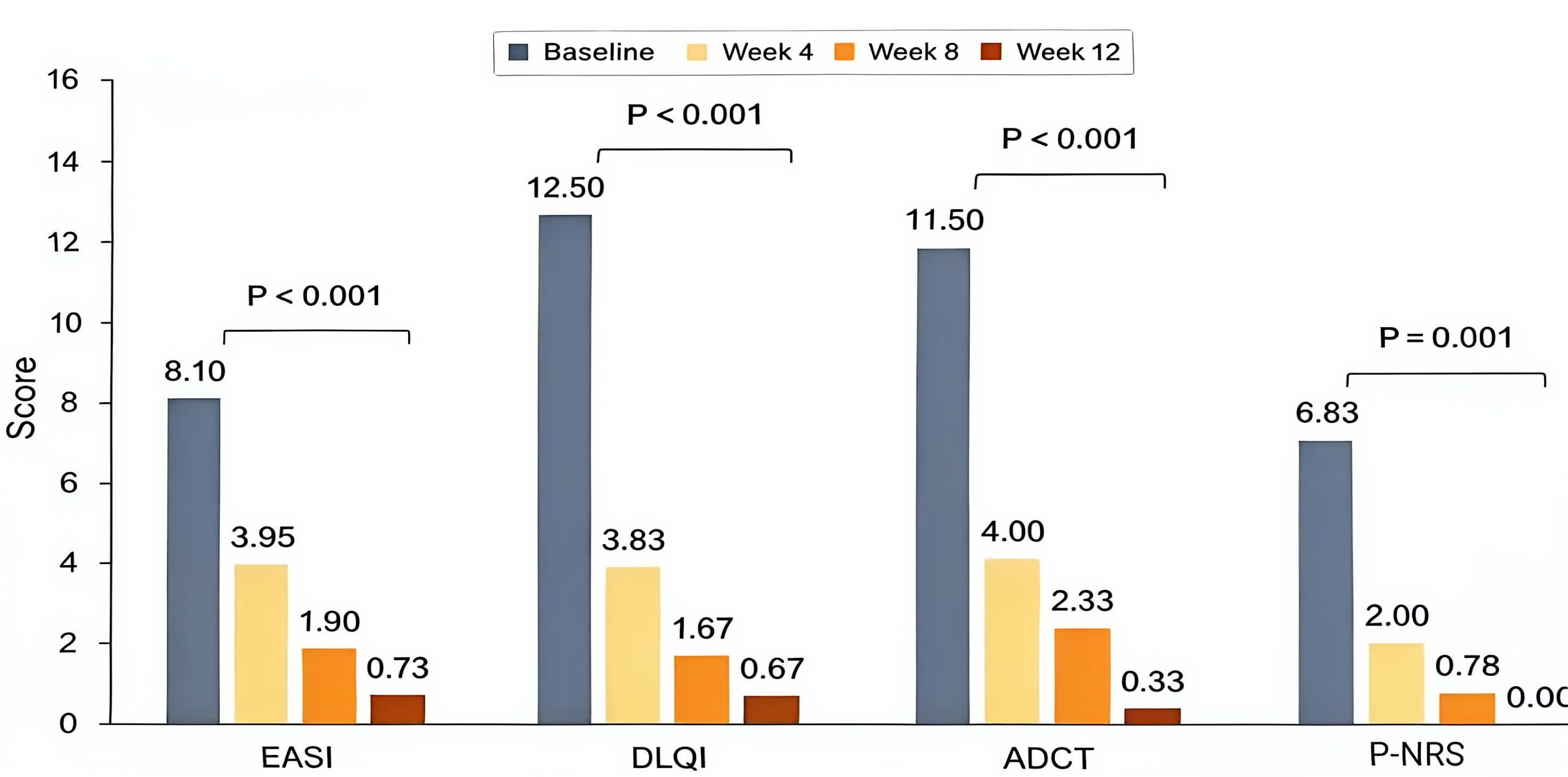
Real-world evidence aligns with Randomised Controlled Trial (RCT) findings. A small case series of six patients with facial and neck AD with inadequate response to dupilumab showed that after 12 weeks of upadacitinib 15 mg, EASI decreased from 8.10 to 0.73; DLQI, Atopic Dermatitis Control Tool (ADCT) and pruritus Numerical Rating Scale (NRS) scores all fell significantly. 100% of patients achieved EASI 75 and 50% achieved EASI 90, with no adverse events reported. The multicentre prospective real-world AD-VISE study similarly confirmed consistent, stable head and neck EASI 75/90/100 response rates at 2, 4 and 6 months of upadacitinib treatment, regardless of baseline disease severity (moderate / moderate-to-severe) or prior biologic exposure (treatment-naïve / previously treated).
5 Summary
Head and neck AD affects exposed skin sites and impairs patients’ daily life and social interaction to a greater extent than AD at other anatomical locations, representing a major unmet clinical need. Its pathogenesis is not driven solely by type 2 inflammation. The involvement of non-type 2 pathways such as Th1/Th17, together with interrelated skin barrier, microbiome and medication-related factors, means therapies targeting type 2 inflammation alone may be insufficient.
Leveraging its mechanism of multi-pathway inflammatory blockade, upadacitinib enables more patients to reach MDA. Multiple studies with stratified head and neck AD endpoints confirm superior efficacy over dupilumab in this subgroup, alongside manageable long-term safety and consistent real-world performance. Upadacitinib constitutes an important therapeutic option for patients with extensive head and neck lesions, inadequate response to prior treatments, or drug-exacerbated AD.
Nevertheless, some patients experience disease fluctuations during long-term follow-up, and roughly 10% fail to achieve full disease control even after switching to upadacitinib. Further novel therapies are anticipated to address the unmet needs of this patient population more comprehensively.
Expert Profile

Professor Qin Haihong
Huashan Hospital, Fudan University
Research focus: clinical and mechanistic research on immune-inflammatory skin diseases including atopic dermatitis