
Professor Gong Chen: Advances in Precision Therapy for Colorectal Cancer — Precision Stratification and ctDNA Quantification | BOC 2026
At BOC2026, Prof. Gong Chen discussed ctDNA-guided treatment, MRD detection, precision stratification, and new strategies for MSS colorectal cancer.
Editor’s Note: At the 2026 Annual Symposium on New Advances in Clinical Oncology in China (BOC) / Best of CSCO 2026 China held in Hohhot in July 2026, FOCUS Clinical Scientists invited Professor Gong Chen from Sun Yat-sen University Cancer Center for an in-depth interview. The discussion covers the construction of precision stratification systems for non-metastatic colorectal cancer, the guiding value of ctDNA in perioperative adjuvant therapy with latest evidence, goal-oriented treatment strategies, and immunotherapy breakthroughs in microsatellite stable (MSS) populations.
FOCUS Clinical Scientists: The diagnosis and treatment paradigm for non-metastatic colorectal cancer has been evolving continuously in recent years. In your view, what are the core advances in this field, and what key dimensions make up the precision stratification system?
Professor Gong Chen:As a surgeon, I focus more on diagnostic and therapeutic progress in non-metastatic colorectal cancer. The core advances in recent years center on precision stratification, which is no less important for early-stage tumors than for advanced tumors. It mainly comprises three core dimensions:
1.Precision stratification by clinical indicators. Taking rectal cancer as an example, risk can be stratified into five tiers — "excellent, good, intermediate, poor, very poor" — via magnetic resonance imaging (MRI) according to ESMO criteria. This is more refined than the traditional rough classification of stage II, stage III and locally advanced disease, and is more likely to yield positive findings in clinical studies.
2.Precision stratification by molecular biomarkers. Alongside progress in molecular diagnosis and treatment for advanced colorectal cancer, various molecular biomarkers are gradually being applied to perioperative treatment decisions for locally advanced disease. The most critical marker is MMR status: patients with dMMR/MSI-H (immunotherapy-sensitive) are prioritized for immunotherapy, while those with pMMR/MSS (immunotherapy-insensitive) receive individualized regimens guided by treatment goals such as rapid tumor shrinkage, organ preservation and functional preservation.
3.Precision stratification by ctDNA (MRD, minimal residual disease). ctDNA is the most important tumor biomarker in solid tumors over the next 5–10 years. Its prognostic value far exceeds current staging and genetic status, as it directly reflects whether residual tumor remains after radical treatment. It enables accurate prognostication and efficacy assessment, and guides perioperative as well as postoperative adjuvant therapy. Theoretically, complete negativity of postoperative ctDNA indicates no residual tumor in the body, and additional adjuvant therapy may be unnecessary.
FOCUS Clinical Scientists: ctDNA testing has become a hotspot in postoperative monitoring for colorectal cancer. How do you evaluate its value in adjuvant therapy decision-making? What key insights have been brought by relevant studies presented at this year's ASCO Annual Meeting?
Professor Gong Chen:As technical standards are gradually unified, clinical evidence has confirmed that ctDNA is the strongest prognostic predictor regardless of the detection platform. By stratifying patients with different prognoses via ctDNA, adjuvant therapy can be targeted to high-risk patients while potentially omitted in low-risk individuals. Three studies on this topic were presented in the oral abstract and rapid oral abstract sessions at this year's ASCO.
The first is a German phase II study in stage II colorectal cancer. In clinical practice, most stage II patients do not receive chemotherapy. Previously, high-risk stage II populations could only be identified by clinicopathological features such as T4 stage, lymphovascular and perineural invasion, and poor differentiation, and chemotherapy benefits only 5%–10% of these patients. The study showed that among stage II patients with positive postoperative ctDNA, the recurrence rate reached 38% in those without chemotherapy, and dropped to approximately 30% after chemotherapy. This finding clearly confirms that ctDNA positivity is a very high-risk factor for recurrence, and ctDNA testing can accurately select patients who truly need adjuvant therapy.
Another key study is the Japanese GALAXY study, currently the most important clinical trial in the field of perioperative ctDNA for stage II/III colorectal cancer worldwide. It adopts Natera's Signatera assay: whole-exome sequencing of primary tumor tissue is first performed to identify 16 tumor-specific mutations, followed by customized amplification-based detection of corresponding tumor-derived DNA in blood. This is widely recognized as the state-of-the-art MRD detection technology. The study has enrolled nearly 5,000 patients, and its data serve as the core reference in the MRD field.
This year, based on an analysis of over 1,500 patients (17% stage I, 75% stage II, 7% stage IV) receiving postoperative chemotherapy, the GALAXY study further defined the guiding value of ctDNA for adjuvant chemotherapy duration. The core conclusions are summarized below:
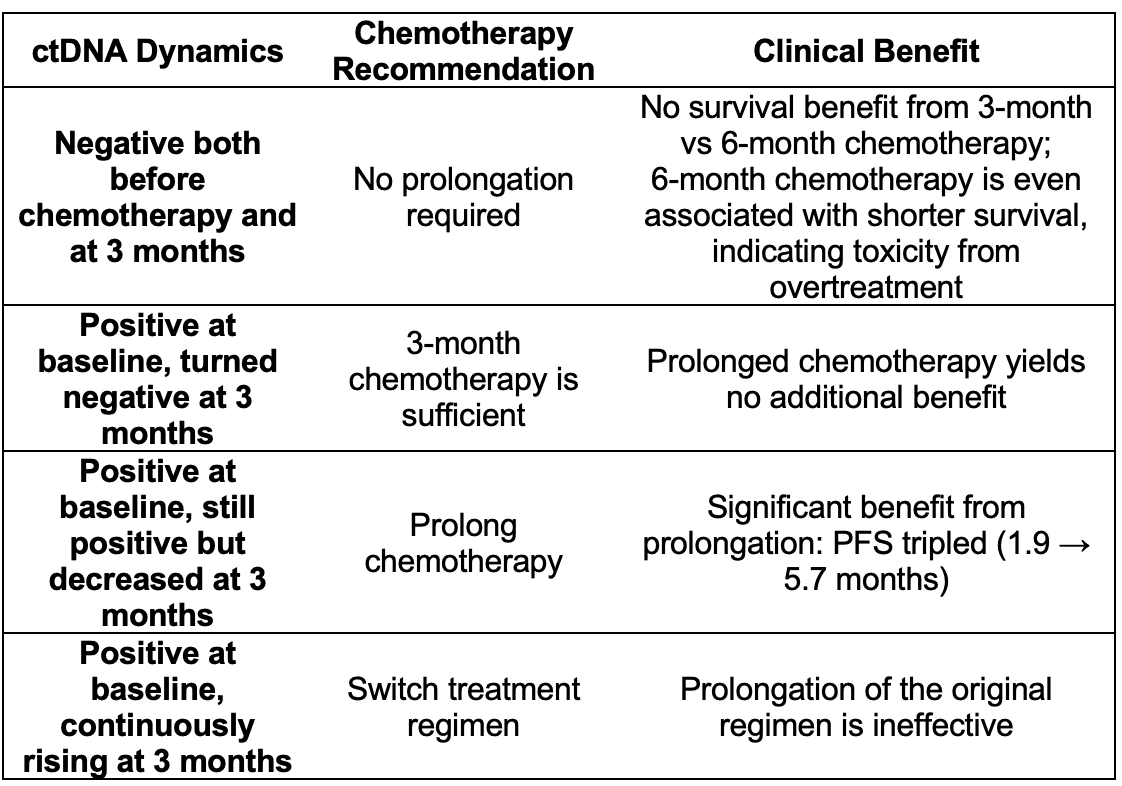
The study also indicates that ctDNA assessment should go beyond binary positive/negative results and advance toward quantitative detection — tracking rise, fall and clearance of ctDNA levels. In the future, a molecular efficacy evaluation framework for adjuvant therapy can be established based on quantitative ctDNA: ctDNA clearance approximates molecular CR, ctDNA decrease approximates molecular PR, and ctDNA rise approximates molecular PD, forming a "molecular RECIST" system for solid tumors. This will be an inevitable direction of development. Led by Academician Ruihua Xu, our team was among the earliest in China to explore ctDNA applications, and our findings align with international trends.
Regarding technology selection, the optimal approach for perioperative MRD detection in colorectal cancer is currently customized MRD testing based on whole-exome sequencing of primary tumor tissue, with a personalized panel for each patient. The 2025 update of CSCO guidelines also specifically notes that not all ctDNA technologies are suitable for perioperative MRD detection, and careful technical differentiation is required in clinical practice.
FOCUS Clinical Scientists: Perioperative treatment of colorectal cancer increasingly follows a "goal-oriented" principle. For the larger population of microsatellite stable (MSS) colorectal cancer, what are the current treatment strategies?
Professor Gong Chen:Colorectal cancer treatment always moves in two directions: intensification to improve efficacy, and de-escalation to reduce toxicity.
MSS colorectal cancer is regarded as a "cold tumor" that barely responds to immunotherapy. Converting cold tumors into "hot tumors" is the fundamental strategy for immunotherapy breakthroughs in this population. In advanced disease, the tumor microenvironment is commonly modulated by anti-angiogenic agents such as small-molecule TKIs regorafenib and sunitinib; in early-stage disease, radiotherapy is a highly effective modulator of the immune microenvironment.
The biggest breakthrough in this field over the past 5 years is that radiotherapy modalities convert MSS colorectal cold tumors into hot tumors, which are then combined with chemotherapy and immunotherapy to enable patients to benefit from immunotherapy. Nearly all relevant studies in the past 3 years have been conducted by Chinese investigators, and this year's ASCO is no exception — the breakthrough study in this field selected by the ASCO Scientific Committee also came from a Chinese team.
Expert Profiles

Professor Gong Chen
Sun Yat-sen University Cancer Center
Chief physician, doctoral supervisor
Deputy Secretary-General and Standing Council Member, Chinese Society of Clinical Oncology (CSCO)
Vice Chairman and Secretary-General, CSCO Colorectal Cancer Committee
Lead writer of CSCO Colorectal Cancer Guidelines